
Table of Contents
ToggleTHE IMPORTENCE OF ARTIFICIAL INTELIGENTS IN SHAPING OUR FUTRE
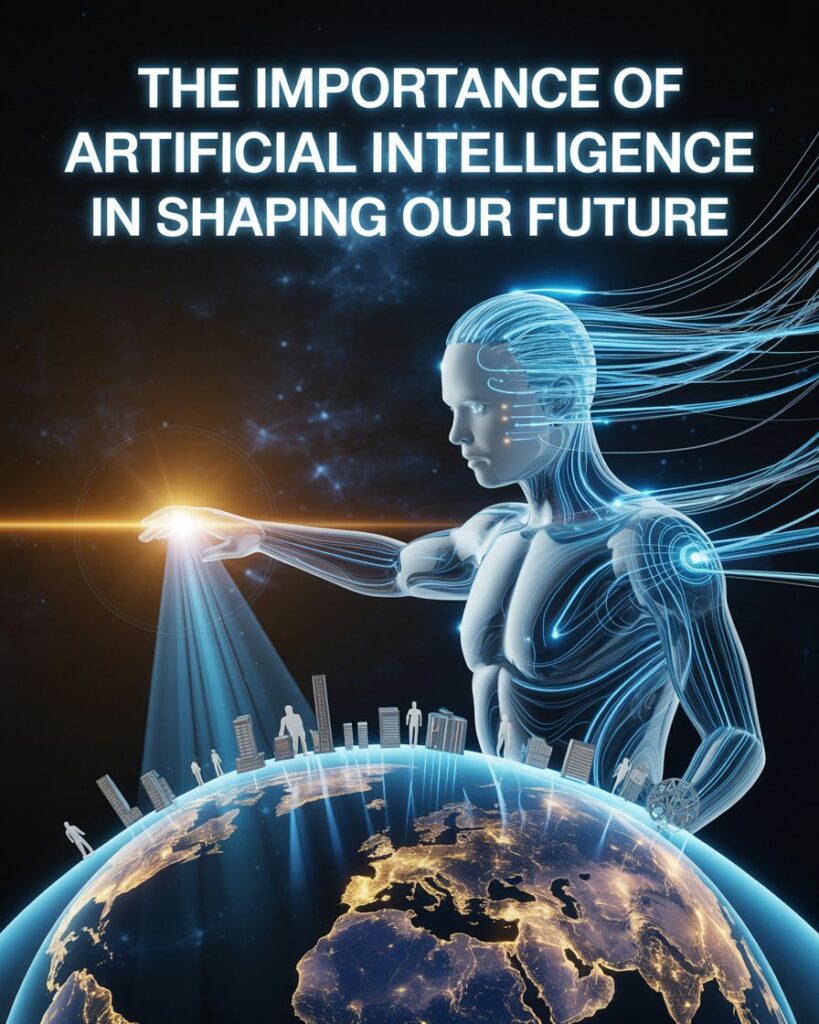
The Importance of Artificial Intelligence in Shaping Our Future: Navigating the 2026 Landscape
Meta Description: Discover how Artificial Intelligence is fundamentally reshaping our future in 2026. From healthcare breakthroughs to the evolution of the global workforce, explore the impact of AI.
If you’re reading this, you’ve likely interacted with Artificial Intelligence at least a dozen times today—perhaps without even realizing it. By 2026, AI has transitioned from a Silicon Valley buzzword into the invisible architecture of our daily lives. It’s no longer just about chatbots that can write mediocre poetry; it’s about the systems managing our power grids, diagnosing rare diseases, and personalizing our education.
The question is no longer if AI will shape our future, but how we will steer the ship.
1. The Catalyst for Global Innovation
In the past, major technological shifts (like the steam engine or the internet) took decades to reach peak impact. AI is moving at a different velocity.
Revolutionizing Healthcare
AI is shifting medicine from “reactive” to “proactive.” We are seeing AI models that can predict heart failure years before symptoms appear and systems that design new drug molecules in weeks rather than years.
-
Precision Medicine: Treatments are now tailored to an individual’s genetic makeup.
-
Radiology 2.0: AI-assisted imaging identifies anomalies with a level of accuracy that minimizes human fatigue errors.
The Climate Fight
In 2026, AI is our strongest ally against climate change. By analyzing massive climate datasets, AI optimizes energy consumption in smart cities and predicts weather patterns with enough precision to protect vulnerable agricultural sectors.
2. Redefining the Workforce: The “Augmented” Employee
There was a time when people feared AI would leave us all unemployed. While some roles have certainly shifted, the reality of 2026 is augmentation, not just replacement.
-
The End of Drudgery: AI handles the “three Ds”: Dull, Dirty, and Dangerous tasks. This frees humans to focus on high-level strategy, creativity, and emotional intelligence.
-
New Career Paths: We’ve seen the rise of “Prompt Engineers,” “AI Ethicists,” and “Algorithmic Auditors”—jobs that didn’t exist a decade ago.
-
The Skill Gap: The importance of AI literacy has become the new “basic computer skills.” Understanding how to collaborate with AI is now a requirement for career longevity.
3. The Ethical Frontier: Trust and Governance
As AI becomes more powerful, the stakes for its governance have never been higher. The importance of AI in our future is directly tied to how we handle the “Black Box” problem—the difficulty of understanding exactly how an AI arrives at a decision.
Key Ethical Challenges:
-
Bias Mitigation: If an AI is trained on biased data, it will produce biased results. Ensuring “Fairness by Design” is the major hurdle for developers this year.
-
Privacy in the Age of Data: How do we fuel AI’s hunger for data without sacrificing individual privacy?
-
Deepfakes and Truth: In a world of generative video and audio, AI-driven verification tools are becoming essential for maintaining public trust.
4. Education and the Democratization of Knowledge
AI is acting as the great equalizer in education. Personalized AI tutors can adapt to a student’s learning speed, language, and interests, making high-quality education accessible to anyone with a 5G connection. This shift ensures that the “future” isn’t just shaped by a small elite, but by a global, AI-empowered workforce.
Final Thoughts: The Human-AI Symbiosis
AI is not a replacement for human intelligence; it is an extension of it. It’s a mirror reflecting our own ingenuity, biases, and potential. As we move deeper into 2026 and beyond, the importance of AI lies in its ability to help us solve problems that were previously “unsolvable.”
The future isn’t a battle between man and machine. It’s a collaboration. And honestly, considering the complexity of the world’s current challenges, we’re going to need all the (artificial) help we can get.